Permanent Filtration System
How the new filtration design lowers running costs, cuts downtime, and speeds up material changes in Metal Additive Manufacturing
Why filtration matters on an SLM machine
Metal 3D printers build finished parts by using a laser to melt metal powder, layer by layer. To keep printing cleanly, every one of these machines needs a filtration system that removes waste from the gas inside the machine. On most machines, this filter is the single part that has to be replaced most often. It drives ongoing running costs, forces regular production pauses, and makes switching from one metal to another slow and messy.
The new permanent filtration system changes the economics of this. Its design protects the main filter so that it no longer clogs and no longer needs to be thrown away and replaced. Instead, it is cleaned in place at the click of a button in the machine's own software.
For the business, this translates into four practical gains: lower running costs, less downtime, faster and cleaner switching between metals, and simpler, safer waste handling.
This article explains the overall technical and commercial value of that design.
The three-stage architecture
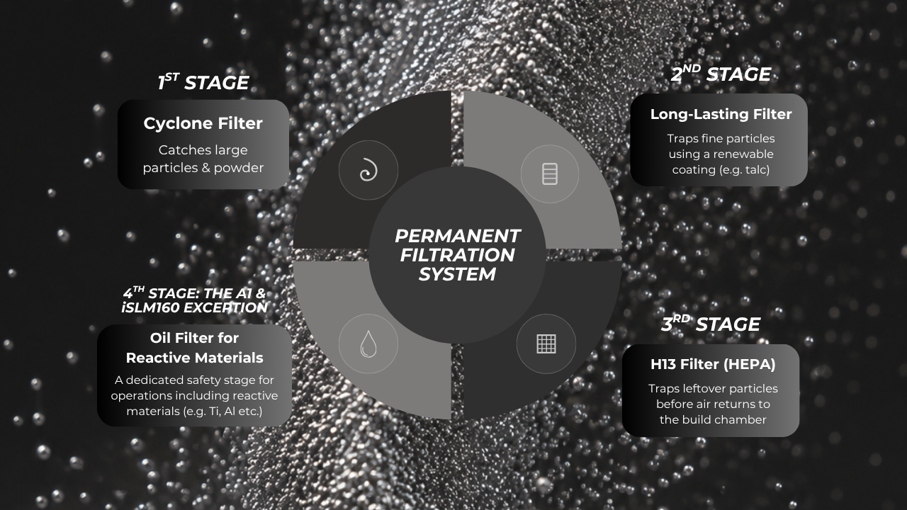
ANiMA’s and ZRapid’s systems separate filtration by particle size, so that each stage only handles what the stage before it could not capture. This is the design principle that makes the second stage long-lasting.
Stage 1 — Cyclone filter
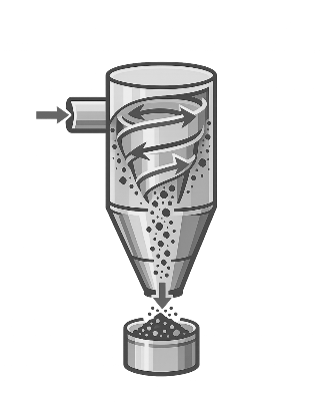
The gas stream enters a cylindrical chamber tangentially, forcing it into a spiral. Heavier particles are thrown outward by centrifugal force, lose velocity against the wall, and fall under gravity into the collection tank below.
|
Captures |
Large particles and unfused powder |
|
Tank contents |
Powder |
|
Maintenance |
Empty the collection tank |
The volume of powder collected at this stage is the same as in previous ZRapid systems. This part of the process has not changed, and it is not intended to. The cyclone is doing exactly what it should: taking essentially all of the powder load before it reaches anything downstream.
Stage 2 — Long-lasting filter
This is where the architecture differs from a conventional arrangement.
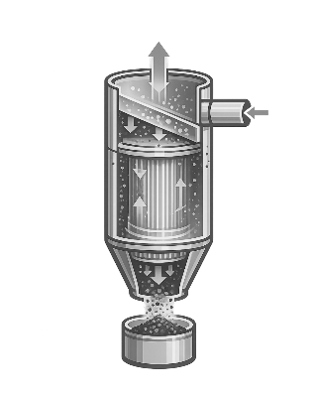
A baffle sits between the cyclone and the filter element. It blocks powder from reaching the filter media entirely. What arrives at this stage is fume condensate only.
That distinction matters because powder, not fume, is what physically blinds a filter element. Powder particles are large enough to lodge in and bridge across the media, progressively blocking flow until the element can no longer be recovered and has to be replaced. Remove the powder from the equation, and the element's working life changes fundamentally.
|
Captures |
Fume condensate |
|
Tank contents |
Fume residue only |
|
Maintenance |
Cleared in place via Reverse Blow; empty the collection tank |
Reverse Blow is pre-configured in the control software. The operator clicks the function, the system reverses the air flow through the filter element, and the accumulated residue is released and drops into the tank below. There is no disassembly, and no element to purchase or install. Reverse Blow is run at regular intervals, based on machine operating time, so the element is kept clear as a matter of routine rather than left to load up. It is also worth running at every material changeover: because the element is cleared in place in a couple of clicks, switching from one alloy to the next is quick and clean, with no residue carried over between materials.
How the element stays clean. It helps to know what the long–lasting filter is actually made of. It is a PTFE (Teflon) element that is coated with a fine layer of talc, and it is the talc, and not the filter surface, that does the catching. Fume and fine particles settle onto the talc layer rather than bonding to the media itself. When Reverse Blow runs, the reversed airflow sheds that talc layer, carrying the trapped residue with it down into the tank, and leaves the element underneath untouched, with nothing adhering to it. The element is then re-coated with a fresh layer of talc, ready for the next cycle. Because it is always the talc that is shed and renewed, the filter itself is never progressively blinded, and it can be cleaned over and over without degrading.
Stage 3 — H13 filter
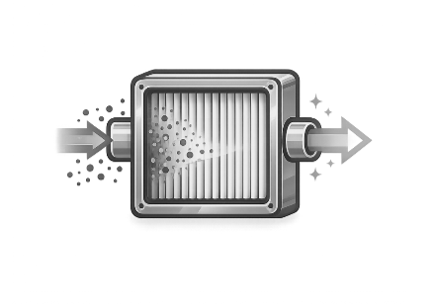
The final stage is the standard square-type H13 filter, unchanged from previous ZRapid systems. H13 is the HEPA classification for filters retaining at least 99.95% of particles at the most-penetrating particle size, and it provides the final polish before clean gas returns to the machine.
|
Captures |
Residual fine particles |
|
Maintenance |
Replaced on the standard schedule |
The ANiMA A1 & iSLM160 exceptions
The ANiMA A1 & ZRapid’s iSLM160 systems add a fourth stage: a dedicated filter for reactive powders, positioned to handle reactive powders such as titanium and aluminum alloys.
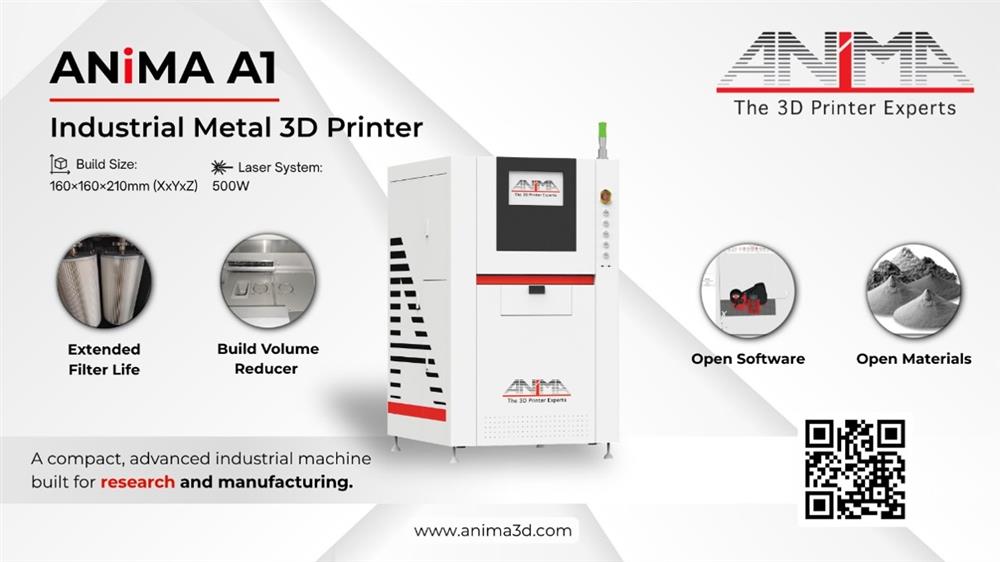
Reactive metal powders such as these carry an ignition and combustible-dust risk, and the moment they are most exposed is when a filter has to be removed for service. This extra stage is built for exactly that moment: it gives you the option of wetting the collected material with oil before the filter is taken out. Before removing the filter, the operator fills its container with oil, which stabilizes the collected reactive particles so the filter can be taken out and handled safely, without the ignition risk that dry reactive powder would otherwise present. The oil is only for this removal step so during the printing process the stage runs dry, like the other filters, with no oil in the circuit while the machine is operating.
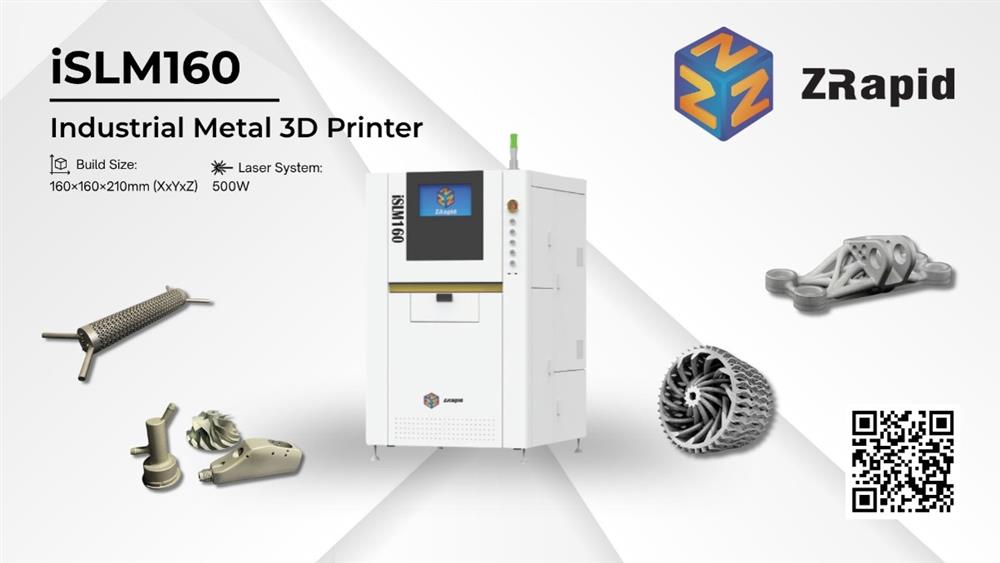
If your production plan includes Ti or Al alloys, this stage is directly relevant to your machine selection and to how you write your local risk assessment.
Note: Filtration hardware is one input to combustible dust and inert-gas safety. Site-level compliance also depends on installation, extraction, waste handling and national regulation. Confirm requirements with your safety authority.
What changed, and what it means in practice
|
|
Conventional arrangement |
New permanent filter system |
|
Powder at Stage 2 |
Reaches the filter element |
Blocked by a baffle |
|
Stage 2 element |
Consumable - clogs and is replaced |
Retained; cleared in place |
|
Cleaning method |
Remove and replace element |
Reverse Blow function in the control software |
|
Operator task |
Filter changeover |
Empty the residue tank |
Four consequences follow:
Faster, cleaner material changes. This is the change operators feel first. Switching alloys used to mean pulling and handling a powder-loaded filter; now the Stage 2 element is cleared from the control software in a couple of clicks. Run Reverse Blow at changeover and the element is emptied of the previous material before the next one goes in, so a material change is quick, clean, and free of cross-contamination between alloys.
Lower consumable cost. The Stage 2 element leaves the recurring purchase list. Only the H13 remains on a replacement schedule.
Less downtime. Clearing the filter in place takes minutes and can be scheduled at material changeover, a step you were already taking. A filter element replacement is a longer intervention.
Simpler, safer handling. The Stage 2 tank contains fume residue, not powder. That is a smaller volume to handle and a different material class to dispose of than a powder-loaded element.
Questions worth asking during evaluation
If you are comparing machines, these are the points that determine whether a “permanent” or “long-life” filter claim holds up in your facility:
1. What is the rated service life of the retained element, and under what conditions? Rated life assumes a defined duty cycle and material mix.
2. How is powder prevented from reaching it? A baffle, a cyclone, or both, and what happens if the upstream stage is not emptied on schedule.
3. Is the cleaning function part of the machine control software, or a separate procedure? Integration determines whether it actually gets done.
4. What still has to be replaced? On this system, the H13, once a year.
5. How are reactive powders handled? Regarding the filter removal step: is there a built-in provision, such as oil-wetting the collected material prior to extraction, to ensure safe servicing after a reactive alloy has been processed?
Conclusion
For your business, a permanent filtration system means lower running costs, less downtime, faster and cleaner material changes, and simpler waste handling. All of this with an added safety option for organisations working with reactive metals. It delivers this by removing the machine's most frequently replaced part from the list of things you have to keep buying and fitting, with a simple software function that keeps the filter clear as a matter of routine. This doesn't eliminate maintenance, and it doesn't claim to, but it does take your single biggest recurring consumable off the table.
Recommended next steps:
1. Request the confirmed service-life figures for the retained filter, and the usage conditions they assume.
2. If your work involves titanium or aluminium, confirm that the ANiMA A1 or iSLM160 configurations and their reactive-metal safety stage suit your needs.
3. Ask for a machine configuration matched to the specific metals and volumes you plan to run.
4. Arrange a discussion with ANiMA to translate these benefits into an estimate for your own facility.